How does the Instagram ranking algorithm actually work? Sadly for solo business owners, the Instagram algorithm doesn’t care that you’re posting in between client calls or admin tasks. It doesn’t care that you don’t have a whole marketing department or hours to spend on content creation. And keeping up with what works and what doesn’t is a full-time job in itself. Never mind also staying on top of the latest feature releases and updates (luckily I do that for you).
I’m breaking down what’s changed for 2026, the ranking factors Instagram has confirmed itself and exactly what to do with that information when you’re the only one doing the marketing.
What is the Instagram algorithm?
The Instagram algorithm is a system with a set of rules that determine which content is shown and in what order. While we refer to the algorithm as a singular thing, there are actually multiple algorithms at play. Instagram has a variety of algorithms, classifiers and processes to determine what content is shown and in what order.
Though this is the case, I also like to swap out ‘algorithm’ for ‘audience’, as it’s Instagram’s users that influence the algorithm. How we use the app, what we watch, what we scroll past and how we spend our time on there all help the algorithm understand what content should be shown to the wider audience versus what shouldn’t be pushed out.
Why do we need an algorithm on Instagram?
When Instagram first launched it was a single stream of photos in chronological order. As Instagram features expanded and more people joined, it was impossible to see everything that was posted.
To help with this, Instagram introduced a ranking system algorithm in 2016. This algorithm’s goal is to keep us on the app for as long as possible. It does this by delivering content we find relevant and interesting.
What’s actually new for 2026
Two things shifted this year that are worth knowing, even though the core ranking signals I’ve just covered haven’t gone anywhere.
- Views became the one metric that matters across every format. Instagram used to make you think in different currencies depending on where you posted, reach for Feed, plays for Reels, taps for Stories. That’s collapsing into Views as a single, comparable number across the board. If you’re checking your own numbers, this is genuinely useful. You can finally compare a Reel against a carousel against a Story without doing mental gymnastics.
- Instagram is leaning further into an interest graph, not just a social graph. In plain terms: your content is now more likely to reach people who’ve never followed you, purely because Instagram predicts they’ll like it, not because they know you. That’s the same shift I mentioned earlier with unconnected reach, but it’s gone further in 2026. For a small account, this is the good news buried in all this algorithm talk. You’re not locked out just because you’ve got 400 followers instead of 40,000.
None of this replaces watch time, likes per reach and sends per reach as your day-to-day signals. Think of Views as the new scoreboard and those three as how you actually win.
How ranking works on Instagram in 2026
Mosseri released a series of videos to share how ranking works in 2026.
He explained that there are two types of ranking on Instagram. These are:
- Connected reach: these are the accounts that follow you
- Unconnected reach: these are accounts that don’t follow you
The most important ranking factors on Instagram
Mosseri shared the top 3 signals for ranking:
- Average watch time: average duration users spend watching a video
- Likes per reach: how many users like a post relative to the number of people who saw it
- Sends per reach: how often users share a post via DM relative to the number of people who saw it
Mosseri noted: “Likes are slightly more important for connected content and sends are slightly more important for unconnected content.”
If you’re looking to grow your account, these are the metrics you need to be optimising for. Use this information to tailor your content, based on the audience it’s intended for and the goal for that post.
Some creators raised concerns about longer videos being penalised on Instagram as people watch a shorter percentage of them. But Adam Mosseri confirmed they don’t get penalised as the number of seconds viewed is also a factor they consider. He explained that the 10 seconds viewed on a 1-minute video is just as important as all 10 seconds viewed on a 10 second video.
How to be recommended on Instagram
In order to be eligible for recommendations, remember:
- No watermarks (especially from other apps)
- Add audio, even on photos or carousels
- Make sure videos are 3 minutes or less
- Post original content
- Good Account Status (check in profile settings)
Mosseri adds that using Trial Reels would be a good way to target unconnected accounts without bothering your connected accounts with too many uploads.
What this means if you’re doing this on your own
Most Instagram advice is written for someone with a content calendar, a scheduler and a person whose whole job is Reels. If that’s not you, here’s the version that fits an actual solo week.
- You don’t need to post daily. You need each post to earn one of the three signals, a longer watch, a like, a share, better than the last one did. Fewer considered posts a week that people actually engage with are better than multiple posts a day that people scroll past.
- You don’t need a following to be found. With the interest graph doing more of the work, a genuinely useful post can reach someone who’s never heard of you, follower count aside.
- And you don’t need to be everywhere. Pick the one format you can actually sustain, Reels if you’re comfortable on camera, carousels if you’re not, and let that carry your account rather than spreading yourself across all four.
How Instagram rank Feed, Reels, Stories and Explore
Each part of Instagram uses its own algorithm tailored to how people use it.
1. How Instagram Feed ranking works
The main Instagram Feed displays content from accounts you follow, alongside recommended posts from accounts you don’t follow but might find interesting.

To determine what content appears on your Feed, Instagram uses a variety of signals, ranked by importance:
- Your activity: Posts you’ve liked, shared, saved, or commented on.
- Information about the post: Factors like how popular a post is (number of likes and how quickly people interact), when it was posted, and any attached location.
- Information about the person who posted: How interesting they might be to you, based on how often people interact with them.
- Your history of interaction: How often you engage with a specific person, such as consistently commenting on each other’s posts.
Using this data, Instagram makes “educated guesses” about how likely you are to engage with a post. The more likely you are to take action and the more heavily that action is weighed, the higher the post appears in your Feed.
2. How Instagram Reels ranking works

Reels are about entertainment and discovery. Most content comes from accounts you don’t follow. Here’s what affects ranking:
- Your activity: Reels you’ve recently liked, saved, reshared, or commented on help Instagram figure out your preferences.
- Interaction history: If you’ve engaged with the creator before, their reels are more likely to show up.
- Reel details: Factors like the audio track, visuals, and overall popularity of the reel help Instagram decide if it’s entertaining.
- Creator details: Popular creators with engaged audiences are more likely to have their reels shown, but Instagram aims to give everyone a chance.
Low-quality reels (watermarked, low resolution, muted or mostly text-based) and content against Instagram’s guidelines are ranked lower.
Instagram released a further update in February 2025 explaining how Reels are ranked and recommended on the platform.
In which, they remind us that Instagram uses signals to predict which Reels people might like. These signals include:
- User activity – watch time, retention, shares, likes and comments
- Audience-matching techniques – looking at people with similar interests
They also explained that when you post a Reel, it’s shown to both followers and non-followers. Among non-followers, your Reel is initially recommended to a small audience who Instagram think will enjoy it. As this audience responds, the best-performing Reels will then be shown to a slightly wider audience, and this process will continue.
Instagram recommends that creators post regularly, as every Reel has the potential to reach a new audience and if your goal is to reach new people, then your Reels should make sense to those who may not know you.
3. How Instagram Stories ranking works

The Instagram Story algorithm works a little differently, as here you will only see Stories from people you follow. Therefore, Stories are ranked based on how much Instagram thinks you’ll want to see them.
Here’s what they look at:
- Viewing history: How often you watch someone’s stories. If you always view their stories, Instagram will prioritise them.
- Engagement history: How much you interact with their stories (sending a like or DM).
- Closeness: Your overall relationship with the person (close friends or family).
Instagram predicts how likely you are to interact with a story to decide the order in your Stories tray.
Mosseri confirmed that the most important signals when ranking Stories are the likelihood that you’ll tap on, like or reply with a message.
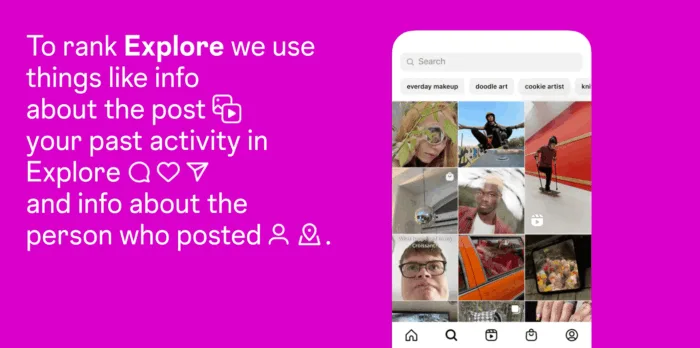
4. How Instagram Explore ranking works
The Explore tab is made up entirely of content from new accounts and displays content that it thinks you’ll be most interested in, based on your previous interactions.
Here’s what influences the ranking:
- Your past activity: The posts you’ve liked, saved, shared, or commented on before influence what’s recommended to you.
- Post popularity: How many likes, shares, comments, and saves a post gets (and how quickly) matters a lot in Explore.
- Interaction history: If you’ve interacted with the person before (even if you don’t follow them), their content is more likely to appear.
- Details about the creator: Posts from accounts that get a lot of engagement from others are prioritised.
Instagram algorithm FAQs
Do I need to post every day for the algorithm to notice me?
No. Consistency matters more than frequency. A handful of posts a week that people actually watch, like or send on will do more for you than daily posting nobody finishes.
Does posting a longer Reel hurt my reach?
No, and Mosseri has said as much directly. Instagram looks at seconds watched, not percentage watched, so 10 seconds of a 3-minute Reel counts the same as 10 seconds of a 10-second one.
Is shadowbanning real in 2026?
There’s no blanket shadowban, but your reach can drop if your account status flags an issue. Worth checking Account status in your settings if your reach falls off suddenly for no obvious reason.
How long does it take to see a change after the algorithm updates?
There’s no fixed timeline Instagram publishes. In practice, give a change a few weeks and several posts before deciding whether it’s actually working, one post either way won’t tell you much.
How to grow on Instagram in 2026
Instagram also recently shared that in 2026 they are focused on two main things: creativity and connection. We know that Instagram are putting a big focus on social aspects of the platform, with Post Share Rates being the key driver of reach.
For creativity, we want to make sure our creative tools are best in class, embrace new technologies, and do more to reward original content. And to help people connect with friends over the things they discover on Instagram, we’re going to double down on messaging, make consuming content more interactive and social, and explore new ways to connect with friends.
So if you’re looking to grow on Instagram in 2026, focus on what people will find entertaining or might have an emotional response to. And, with Reels expanding to 3 minutes, you can really utilise storytelling elements to grab attention!
Experiment as much as possible, this will give you the best insights into what your ideal audience responds to.